

How to Choose Pyjama Size: Reading UK Size Charts for S, M and L
You can be a UK 12 in one shop and a UK 14 in another, and pyjamas make it worse because the label often says S, M or L instead of a dress size. The good news is that a tape measure and two minutes will settle it. This guide shows what to measure, how to read a size chart, and what to do when you land between two sizes.
Why UK sizes are not the same everywhere
There is no law in the UK that fixes what a size 12 must measure, so every brand sets its own. Nightwear adds a second problem: many sets are made overseas and labelled in letters (S, M, L, XL) that follow Asian sizing, which often runs one or two sizes smaller than UK sizing. The result can be a label that says XL on a set that fits smaller than the UK size you expect. Sets that print UK sizes on the label, such as S (UK 8 to 10) through XL (UK 20 to 22), take most of the guesswork away, but a chart in centimetres is still the most reliable thing to check.
The three measurements to take
Use a soft tape measure over thin clothing or underwear, keep it level and snug but not tight, and stand relaxed.
- Bust: around the fullest part of your chest.
- Waist: around the narrowest part of your middle, usually just above the navel.
- Hips: around the widest part of your hips and bottom.
Write all three down in centimetres. If your measurements fall into different sizes on the chart (many people are one size up on the hips), go by the largest. For a two-piece set, the top follows your bust and the bottoms follow your hips, so check each half against its own column.
Body measurements and garment measurements are different
This is the bit most people miss. A body chart tells you what size of person the garment is made for. A garment chart tells you how big the pyjamas themselves are, laid flat and measured across. Sleepwear is cut with room to move in, so the garment figure is always bigger than your body.
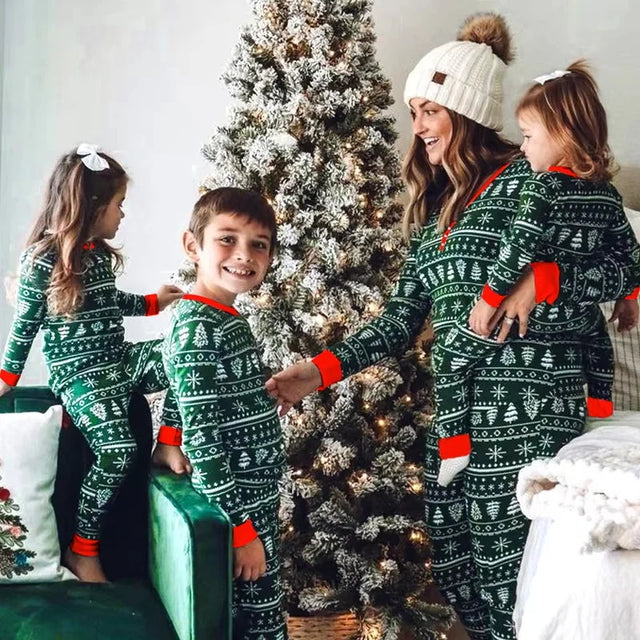
Here is a real example. In our Mum sizes for matching family Christmas pyjamas, the garment chest is 88cm for a UK 8, 93cm for a UK 10, 98cm for a UK 12, 103cm for a UK 14, 108cm for a UK 16 and 113cm for a UK 18. That is a 5cm step with every size. The chest figure is the pyjamas, not you, so it is roomier than your body.
If a chart gives a flat width (say 50cm across the chest), double it to get the full circumference (100cm). Then compare that with your bust. The garment should come out bigger than your bust, and the gap is what gives a relaxed fit. The simplest check of all is to lay a pair of pyjamas you already love flat on the bed and measure them the same way. Anything close to that number will feel familiar.
When you are between two sizes
Size up. A set that is slightly large is far more comfortable to sleep in than one that pulls across the shoulders or rides up when you turn over. The exception is a style with a drawstring or wide elastic waist that you plan to wear as loungewear, where your usual size is usually fine.
Fabric changes the answer too:
- Cotton jersey, fleece and anything with spandex has give, so true to size is usually fine.
- Satin and silky polyester has almost no stretch at the seams, so go up a size if you are close.
- Button-up tops should be sized for the bust so the buttons sit flat and do not gape.
- Hooded and sherpa-lined sets are bulky, so a snug size can feel restrictive in the shoulders.
Length matters as much as width
Charts often skip leg length and sleeve length, and these are the measurements that go wrong most on tall or petite frames. If a listing gives an inside leg or sleeve figure, check it against a pair you own. If it does not, treat that as a reason to take a little extra care, because the supplier simply has not told you. As a rule of thumb, if you are taller than average, choose the larger size even when your widths say otherwise.
Finding your size in our range
Many sets in our women's pyjamas range list the UK size range next to each size option, for example Small (UK 8 to 10) or Large (UK 16 to 18), so you can match your measurements to a UK size straight away. Where a product page gives a size chart, check it before you order.
If you are a UK 18 or above, or you have been caught out by letter sizes before, the plus size pyjamas collection only includes sets that come in at least a UK 20 to 22 or a 3XL, so you will not be browsing sizes that stop short.
For nightdresses, chemises and other cuts that hang from the shoulders, the bust and length matter more than the waist, which makes women's nightwear a good place to put the measuring advice above to work.
If you want something to layer over your pyjamas, check the length and fabric in our dressing gowns and robes, and measure against a robe you already own.
A quick checklist before you order
Measure your bust, waist and hips in centimetres. Decide whether the chart you are reading is a body chart or a garment chart. Compare each half of a two-piece set with its own measurement. Size up if you are between sizes or the fabric has no stretch. And keep your pyjamas away from heaters, fires and candles, whatever size you choose.